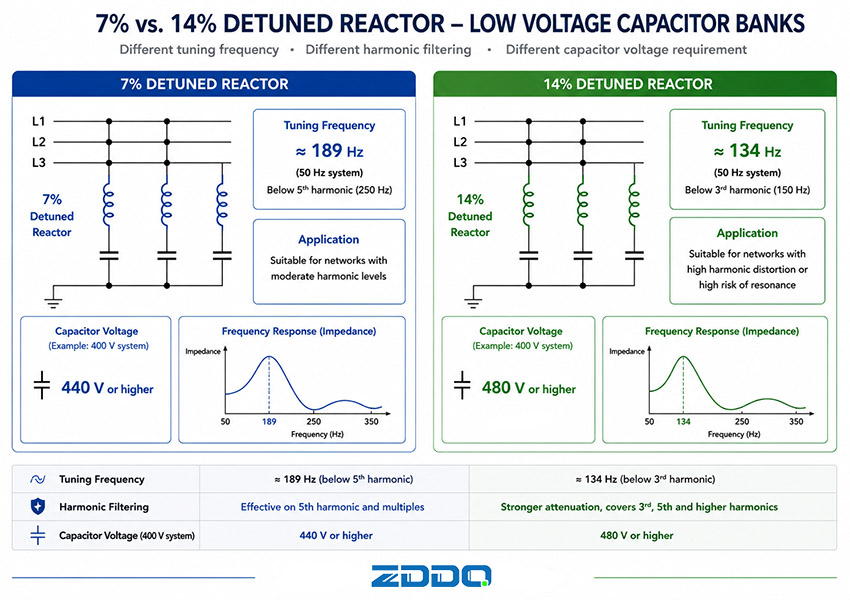
Un reactor de rechazo del 7% crea normalmente una frecuencia de sintonización de aproximadamente 189 Hz en un sistema de 50 Hz, que está por debajo de la frecuencia del 5º armónico (250 Hz). Se utiliza comúnmente en redes eléctricas con niveles armónicos moderados, especialmente donde la distorsión del 5º armónico es la principal preocupación.
Un reactor de rechazo del 14%, con una frecuencia de sintonización más baja de aproximadamente 134 Hz, proporciona un rechazo más fuerte y generalmente se selecciona para redes con condiciones armónicas más severas o un mayor riesgo de resonancia armónica.
La selección del reactor también afecta directamente al requisito de tensión del condensador. Debido a que el reactor y el condensador forman un circuito en serie, el condensador puede experimentar una tensión superior a la tensión nominal del sistema.
Por ejemplo, en un sistema de 400 V:
reactor del 7%: Los condensadores suelen estar clasificados a 440 V o más.
reactor del 14%: Los condensadores suelen estar clasificados a 480 V o más, dependiendo de las condiciones armónicas reales del sistema y de los requisitos de diseño.
Además, la potencia reactiva (kvar) del condensador debe ajustarse cuidadosamente con el reactor. El reactor cambia la impedancia del circuito y afecta la salida de potencia reactiva real del banco de condensadores.
Por lo tanto, elegir entre reactores del 7% y del 14% no debe basarse solo en la capacidad del banco de condensadores. Un análisis armónico adecuado es esencial para garantizar un funcionamiento seguro, evitar la resonancia y prolongar la vida útil del condensador.
En resumen: el 7% es una solución común para entornos armónicos moderados, mientras que el 14% proporciona un rechazo más fuerte para condiciones de calidad de energía más exigentes.
Categorías
nuevo blog


NO.25,JINHE RD,HUAIYUAN ECONOMIC DEVELOPMENT ZONE ,BENGBU,ANHUI


Scan to WhatsApp: