A primera vista, un factor de potencia cercano a 1.00 parece ideal. Pero para un generador, una compensación excesiva de potencia reactiva puede crear condiciones de operación menos estables y potencialmente perjudiciales para el propio generador. Por lo tanto, el objetivo debería ser una corrección optimizada del factor de potencia, no simplemente el factor de potencia más alto posible.
Cuando una carga es alimentada por una red eléctrica pública, la red suele ser muy grande en comparación con la carga individual. Su tensión y frecuencia son relativamente rígidas, por lo que los cambios moderados de potencia reactiva tienen una influencia limitada en el sistema general.
Un generador es diferente.
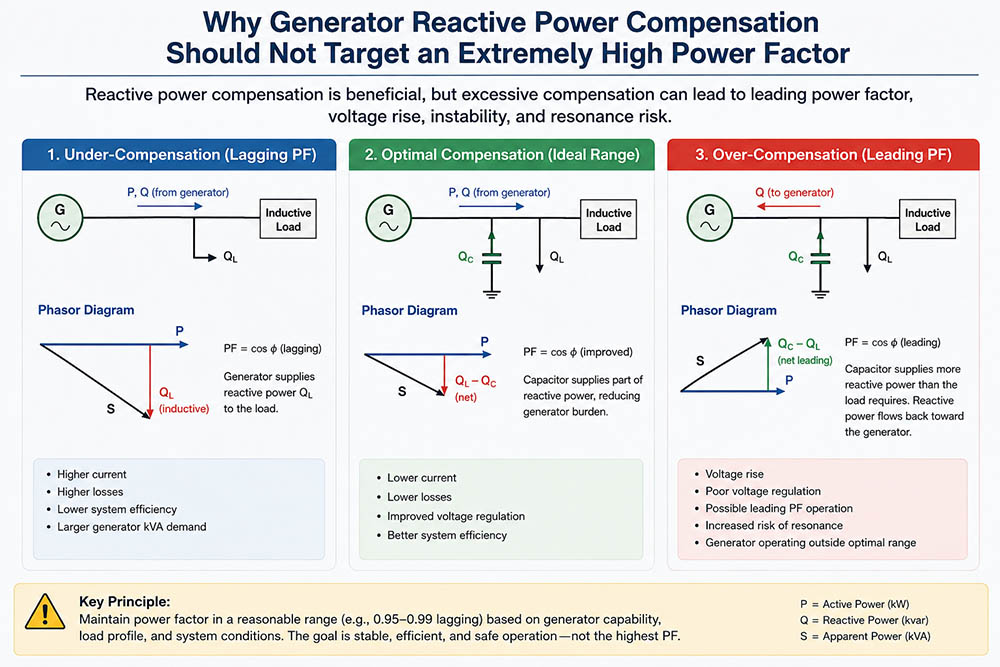
Un generador tiene una capacidad limitada y su tensión está estrechamente relacionada con su sistema de excitación y su salida de potencia reactiva. Si un banco de capacitores se conecta para compensar cargas inductivas, la demanda de potencia reactiva del generador disminuye.
Esto suena positivo, y normalmente lo es.
El problema comienza cuando la compensación continúa más allá de la demanda reactiva real de las cargas.
Una vez que el sistema queda sobrecompensado, el generador puede dejar de suministrar potencia reactiva a la carga. En su lugar, la potencia reactiva puede comenzar a fluir desde el banco de capacitores hacia el generador.
En otras palabras, el generador puede verse obligado a operar en una condición de factor de potencia adelantado.
Para una carga inductiva convencional, el generador normalmente suministra tanto potencia activa como cierta cantidad de potencia reactiva.
Una relación simplificada es:
S² = P² + Q²
donde:
P = potencia activa
Q = potencia reactiva
S = potencia aparente
La compensación reduce Q y, por lo tanto, reduce la carga de potencia aparente del generador.
Pero si Q se reduce demasiado y se vuelve negativa, el generador entra en una condición de potencia reactiva adelantada.
Esta es una distinción importante: reducir la potencia reactiva es beneficioso solo mientras la compensación permanezca dentro de un rango operativo adecuado.
Un factor de potencia de 0.95 o 0.98 puede ser técnicamente más práctico que intentar forzar al sistema a mantenerse exactamente en 1.00 bajo cualquier condición de carga.
Una de las principales preocupaciones con una compensación excesiva es el aumento de tensión.
Los bancos de capacitores generan potencia reactiva. Cuando el generador está ligeramente cargado y permanece conectada una gran cantidad de capacitancia, la potencia reactiva capacitiva puede volverse significativo en comparación con la carga real del generador.
Debido a que un generador no es una barra infinita, esta potencia reactiva puede tener una influencia notable en la tensión terminal.
El resultado puede incluir:
Aumento de la tensión terminal del generador
Fluctuaciones de tensión durante cambios de carga
Regulación de tensión más difícil
Mayor esfuerzo en el aislamiento y los componentes eléctricos
Funcionamiento inestable de cargas sensibles
Esto es particularmente importante para sistemas donde la carga del generador cambia con frecuencia.
Un banco de capacitores que es perfectamente adecuado cuando el generador está muy cargado puede volverse excesivo cuando la carga disminuye repentinamente.
Los generadores síncronos tienen límites operativos específicos para la potencia reactiva.
Cuando funcionan con un factor de potencia adelantado, el generador entra en una región diferente de su curva de capacidad. Una potencia reactiva adelantada excesiva puede afectar al sistema de excitación y la estabilidad del generador.
En aplicaciones prácticas, el fabricante del generador normalmente especifica un rango operativo permitido para la potencia reactiva.
Por lo tanto, la compensación no debe diseñarse únicamente en torno a un objetivo como:
“Cuanto más cerca de 1.00, mejor.”
En su lugar, los ingenieros deben considerar la curva de capacidad P-Q, las características de excitación, la carga mínima y el perfil dinámico de carga.
Esto es especialmente importante para generadores de reserva, donde la carga real puede variar significativamente con el tiempo.
Los capacitores no simplemente “eliminan” la potencia reactiva. También cambian las características eléctricas del sistema.
Los generadores tienen reactancias subtransitorias, transitorias y síncronas, mientras que los bancos de capacitores introducen reactancia capacitiva. Juntos, estos elementos pueden crear condiciones de resonancia.
Si cargas no lineales como:
Variadores de frecuencia
Sistemas UPS
Rectificadores
Fuentes de alimentación conmutadas
Equipos de centros de datos
se conectan al mismo sistema de generador, las corrientes armónicas pueden interactuar con el banco de capacitores.
Esto puede resultar en:
Amplificación de armónicos
Sobrecalentamiento de capacitores
Distorsión de tensión
Disparos de protección
Reducción de la vida útil del capacitor
Por lo tanto, simplemente aumentar la capacitancia hasta que el factor de potencia alcance un valor extremadamente alto no es una estrategia completa de calidad de energía.
Imagine un generador que suministra energía a una fábrica.
Durante la producción máxima, la fábrica consume una potencia reactiva inductiva considerable. Un banco de capacitores puede compensar eficazmente esta demanda.
Pero durante la noche, muchos motores y máquinas de producción se apagan.
La carga activa disminuye, y la carga reactiva inductiva también disminuye. Si la misma capacidad de los condensadores permanece conectada, el sistema puede quedar repentinamente sobrecompensado.
Por eso la compensación automática de potencia reactiva suele ser generalmente preferible a un banco de condensadores conectado permanentemente en aplicaciones con generadores.
El sistema de compensación debería responder a las condiciones reales de funcionamiento en lugar de mantener la capacitancia máxima en todo momento.
No existe un valor universal de factor de potencia que sea ideal para todos los sistemas de generadores.
Un objetivo razonable debería determinarse mediante:
Requisitos del fabricante del generador
Carga mínima del generador
Características de la carga
Requisitos de arranque de motores
Contenido armónico
Sistema de excitación del generador
Configuración del banco de condensadores
Requisitos de regulación de tensión
En muchos sistemas prácticos, mantener el factor de potencia alrededor de 0.95–0.99 puede proporcionar un mejor equilibrio que forzarlo continuamente a exactamente 1.00 o llevarlo a una región adelantada.
Sin embargo, el valor exacto siempre debe confirmarse con los límites de funcionamiento del fabricante del generador y el diseño real del sistema.
La compensación de potencia reactiva no es una competencia para lograr el factor de potencia más alto posible.
El objetivo real es lograr un punto de funcionamiento estable, eficiente y seguro.
Para aplicaciones con generadores, una buena compensación debería:
Reducir la corriente reactiva innecesaria
Disminuir la demanda de potencia aparente del generador
Mejorar la estabilidad de tensión
Evitar el funcionamiento con factor de potencia adelantado
Minimizar los riesgos de resonancia armónica
Adaptarse a las cargas cambiantes
Mantenerse dentro de la capacidad de potencia reactiva del generador
En otras palabras, la mejor compensación no es la compensación máxima, sino la compensación adecuada.
La corrección del factor de potencia puede mejorar significativamente la eficiencia del sistema del generador, pero una compensación excesiva puede crear nuevos problemas en lugar de resolver los antiguos.
Cuando un banco de condensadores lleva al generador hacia un factor de potencia extremadamente alto o adelantado, el sistema puede experimentar aumento de tensión, regulación de tensión inestable, condiciones de funcionamiento desfavorables del generador y resonancia armónica.
Por esta razón, la compensación de potencia reactiva del generador debería diseñarse en torno al perfil de carga actual y capacidad del generador, en lugar de simplemente buscar un factor de potencia lo más cercano posible a 1,00.
Un sistema de compensación bien diseñado debería hacer que el generador funcione eficientemente sin forzarlo fuera de su región de funcionamiento preferida.
Para aplicaciones de calidad de energía, el enfoque más inteligente es sencillo:
Compense lo suficiente para mejorar la eficiencia, pero no tanto como para que la propia compensación se convierta en un problema.
Categorías
nuevo blog


NO.25,JINHE RD,HUAIYUAN ECONOMIC DEVELOPMENT ZONE ,BENGBU,ANHUI


Scan to WhatsApp: